Product Marketing / Platform Migration / Developer Enablement
QNX SDP 8.0
Transitioning existing customers from SDP 7.1 to the next-generation SDP 8.0 — designing a product page that showcased performance benchmarks, toolchain advancements, and a clear migration path to drive adoption.
01
The challenge
QNX SDP 7.1 was a mature, trusted platform — but it was built for a previous generation of hardware. Customers building next-generation systems needed support for 64-bit ARM and x86 architectures, scalability across 4 to 64-core SoCs, and modern developer tooling. The challenge was convincing existing 7.1 customers to migrate while also attracting new developers evaluating embedded RTOS platforms for the first time.
Stale positioning
SDP 7.1 page used generic messaging ("A real-time operating system for critical embedded systems") with no urgency to upgrade.
Outdated toolchain
GCC 8.3 toolchain, Eclipse-only IDE — no VS Code support, no modern developer experience story.
Hardware limitations
No messaging around multi-core scalability, 64-bit support, or future-proof architecture for next-gen SoCs.
No migration path
No clear comparison between 7.1 and 8.0 — developers had no reason to invest time in upgrading.
02
The page before
The SDP 7.1 page was a text-heavy product listing. It described the Neutrino RTOS, Momentics Tool Suite, and Software Center as standalone features — but gave no sense of platform vision, performance, or future direction.
03
The strategy
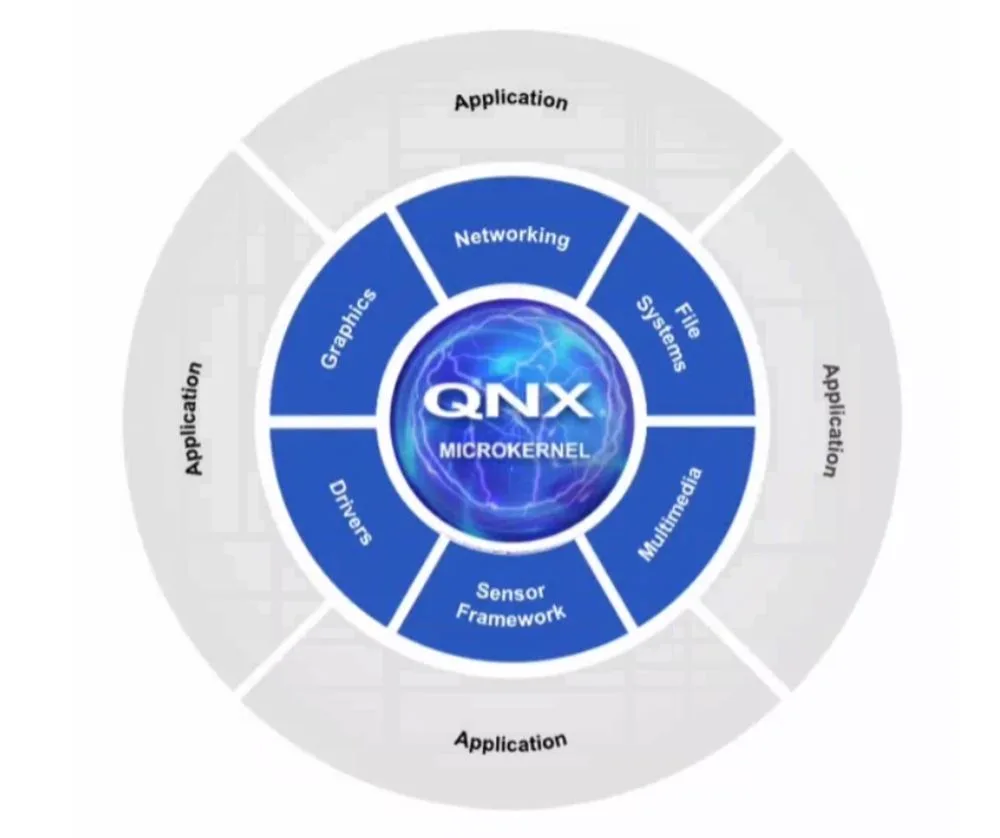
I designed the SDP 8.0 page to make the upgrade decision obvious. Instead of listing features, the page was structured around what customers gained by moving to 8.0: hard real-time performance, effortless scalability, low latency and jitter, state-of-the-art tooling including VS Code support, and a future-proof microkernel architecture built for the next decade of hardware.
A free trial funnel with a clear 3-step getting-started flow replaced the generic "Talk to Us" CTA — lowering the barrier for both existing customers evaluating the upgrade and new developers trying QNX for the first time.
04
The transformation
The SDP 8.0 page shifted from a static product listing to a performance-driven platform story.
Performance-first messaging
"High performance meets safety and security" — leading with the 8.0 advantage rather than generic RTOS features.
Six key differentiators
High Performance, Effortless Scalability, Hard Real Time, Low Latency & Jitter, State-of-the-Art Tools, Future-Proof Architecture — each with its own dedicated section and visual.
Free trial conversion funnel
A 3-step getting-started flow (Login → License form → Receive license) with a Product Brief download — capturing leads and reducing adoption friction.
Modern developer story
VS Code Toolkit, next-gen microkernel, 64-core scalability — positioned QNX as a forward-looking platform, not a legacy RTOS.
05
Impact
The SDP 8.0 page gave existing customers a clear reason to upgrade and new developers a low-friction way to evaluate the platform. The free trial funnel replaced a passive "contact us" gate with an active conversion path, and the performance benchmarks gave the sales team concrete data to reference in customer conversations.
By making the upgrade path visible and the trial process self-serve, the page helped drive customer migration from 7.1 to 8.0 while positioning QNX as a platform built for the next generation of embedded systems.
View more projects